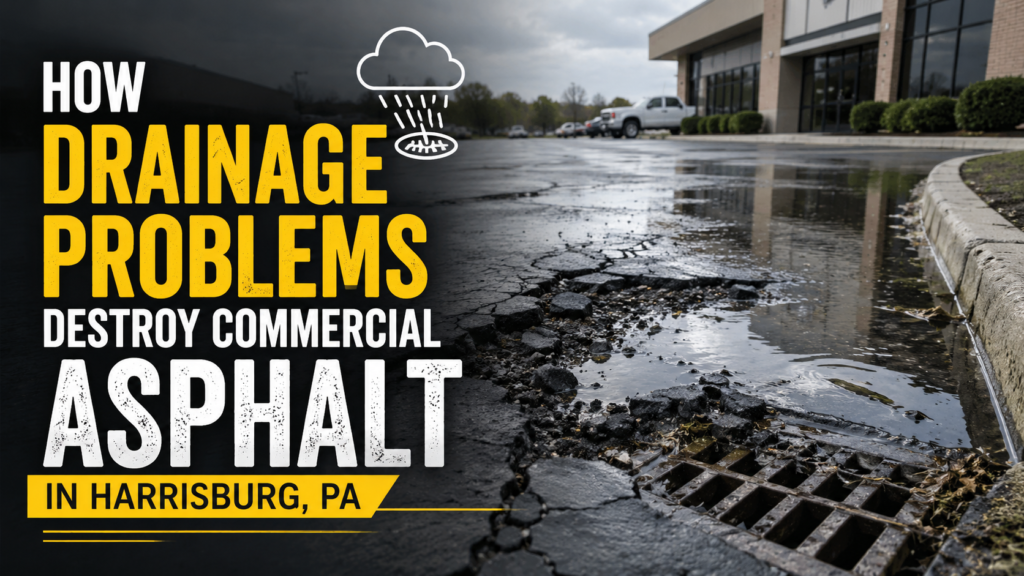
Of all the forces working against commercial asphalt in Harrisburg, drainage failure is arguably the most insidious because its effects are initially invisible and its consequences are disproportionately severe. Water is asphalt pavement greatest long-term enemy, and drainage failures are the mechanism through which water gains prolonged access to the pavement structure. In Central Pennsylvania where 44 to 46 inches of annual precipitation falls throughout the year, and where freeze-thaw cycling amplifies every drop of water that reaches the base, drainage is the central determinant of Commercial Asphalt Service Harrisburg longevity in the Harrisburg market.
Why Water Is So Damaging to Asphalt Pavement
- Binder stripping: Water that infiltrates the asphalt mix works between the binder and aggregate particles, breaking the adhesive bond that gives asphalt its strength. This process stripping weakens the entire pavement structure from within and is accelerated by freeze-thaw cycling.
- Base saturation: Water passing through the asphalt surface and entering the aggregate base saturates the material, reducing its load-bearing capacity. Saturated base under commercial traffic loads deforms rapidly, creating alligator cracking, rutting, and potholes.
- Sub-grade softening: In clay-rich Harrisburg-area soils, prolonged moisture exposure causes the sub-grade to lose bearing capacity as clay absorbs water and becomes yielding. A soft sub-grade fails upward through the entire pavement structure.
- Freeze-thaw amplification: Water reaching the base or sub-grade before freezing temperatures arrive subjects the foundation to the 9 percent volumetric expansion of the freeze cycle. This expansion displaces aggregate particles, creates voids, reduces compaction density, and manifests as cracking and settlement in the surface above.
Common Drainage Failure Modes in Harrisburg Commercial Properties
- Inadequate surface slope: Commercial lots must have sufficient slope typically 1 to 2 percent minimum to move water off the surface. Lots inadequately graded at installation, or whose drainage grades have been compromised by settlement, develop ponding areas where water sits in extended contact with the pavement.
- Clogged or inadequately sized catch basins: When catch basins are clogged with debris or undersized for their drainage area, water backs up and floods pavement surfaces during and after rain events.
- Edge drainage failure: Water running off paved surfaces should be captured by edge drainage features. When edge drainage is absent or blocked, water infiltrates the base through the most permeable boundary of the entire pavement structure.
- Sub-surface drainage failure: In areas with high water tables or expansive clay soils common in parts of the Harrisburg region, sub-surface drainage infrastructure is necessary to intercept groundwater before it saturates the base. When absent or failed, seasonal water table fluctuations repeatedly wet and dry the base, accelerating degradation.
Diagnosing Drainage Problems
Property managers can identify drainage-related pavement deterioration through observable indicators: areas of recurring ponding that drain slowly after rain; pavement distress concentrated in low areas or along lot edges; alligator cracking appearing first and most severely where water visibly pools; and accelerated deterioration near catch basins that may be functioning inadequately. A qualified pavement contractor can perform a formal drainage assessment using laser-guided instruments to evaluate surface slopes, test catch basin function, and identify where sub-surface drainage infrastructure may be needed.
Drainage and Pavement Maintenance: The Critical Relationship
One of the most important principles in commercial asphalt management in Harrisburg is this: pavement maintenance treatments cannot overcome drainage failures. Sealcoating a lot that pools water extends surface layer life minimally, because water infiltration through pooling areas continues to damage the base below. Crack sealing a surface without adequate drainage temporarily delays deterioration but does not prevent the base damage the drainage problem continuously causes. The correct sequence is to address drainage deficiencies first, then apply surface maintenance treatments whose effectiveness depends on a dry, structurally sound base.
Conclusion
Drainage problems destroy commercial asphalt in Harrisburg by providing the continuous water access that activates every other deterioration mechanism binder stripping, base saturation, sub-grade softening, and freeze-thaw damage. Commercial property owners who invest in proper drainage design at installation, maintain catch basins and drainage structures regularly, and address drainage deficiencies before applying surface maintenance treatments protect their asphalt investment at the most fundamental level. In Central Pennsylvania precipitation environment, pavement that drains well lasts; pavement that does not drain fails predictably and expensively.